Within the program “Ecosystems of the Siberian Arctic Seas,” carried out by Shirshov Institute of Oceanology, Russian Academy of Sciences since 2007, studies of the water structure and spatial variability of the parameters of the carbonate system have been performed, and the intensity and direction of the carbon dioxide flux over the continental slope of the Laptev Sea and in the Vilkitsky Strait in September 2018 have been calculated. The presence of several main water masses that govern the water structure in the study area is shown. A strong spatial variability of the parameters of the carbonate system of seawater, determined by complexes of physical and chemical–biological processes, has been revealed. The intensity and direction of the carbon dioxide flux at the water–atmosphere boundary were calculated, which range from –12 to 4 mmol m–2 day–1. It was revealed that the investigated area of the outer shelf and continental slope of the Laptev Sea is an emitter of carbon dioxide into the atmosphere as of September 2018. Conversely, the area of the Vilkitsky Strait, is a CO2 sink zone.
Continue reading ‘Water structure and carbon dioxide flux over the Laptev Sea continental slope and in the Vilkitsky Strait in the autumn season’Archive Page 2
Water structure and carbon dioxide flux over the Laptev Sea continental slope and in the Vilkitsky Strait in the autumn season
Published 17 November 2023 Science ClosedTags: Arctic, chemistry, field
Impact of ocean acidification on coral reefs and the marine ecosystems in Phillipines
Published 17 November 2023 Science ClosedTags: biological response, corals, policy, review, South Pacific
Purpose: The aim of the study was to investigate the impact of ocean acidification on coral reefs and the marine ecosystems in phillipines
Methodology: The study adopted a desktop methodology. Desk research refers to secondary data or that which can be collected without fieldwork. Desk research is basically involved in collecting data from existing resources hence it is often considered a low cost technique as compared to field research, as the main cost is involved in executive’s time, telephone charges and directories. Thus, the study relied on already published studies, reports and statistics. This secondary data was easily accessed through the online journals and library
Findings: Ocean acidification reduces the density and growth of coral skeletons, making them more vulnerable to erosion. This threatens coral reefs and the marine life that depends on them. It also affects human benefits from coral reefs, such as fisheries, tourism and storm protection.
Unique Contribution to Theory, Practice and Policy: Theory of Ocean Acidification and Coral Calcification, Theory of Ocean Acidification and Biodiversity Loss and Theory of Adaptation and Resilience of Coral Reefs may be used to anchor future studies on impact of ocean acidification on coral reefs and the marine ecosystems in Philippines. Philippine government should actively participate in global climate agreements and implement policies to reduce carbon emissions at the domestic level. The Philippine government should integrate ocean acidification considerations into national environmental policies and action plans, such as the Philippine Coral Reef Protection Program.
Continue reading ‘Impact of ocean acidification on coral reefs and the marine ecosystems in Phillipines’The modulating role of natural variability in the biological response to ocean acidification
Published 16 November 2023 Science ClosedTags: abundance, biological response, calcification, echinoderms, growth, laboratory, morphology, mortality, North Atlantic, otherprocess, reproduction
Ocean acidification (OA) is the consequence of the uptake of excess carbon dioxide from the atmosphere. Along the coastal zone, ocean acidification is influenced by other processes such as biology and currents, leading to high levels of natural variability in pH. While the impact of pH on marine organisms is better resolved, the modulating role of this natural variability is poorly understood. This master’s thesis aimed at evaluating diel pH fluctuations using the larval stages of the brittle star Amphiura filiformis. Results revealed the importance of acknowledging pH variations with individuals exhibiting higher fitness. Diel analyses also underscored the existence of an intrinsic circadian cycle where larvae would grow more during the daytime than nighttime, possibly explained by better conditions encountered during the day. In addition, we demonstrated a carryover effect that could also be associated with a stage sensitivity. We suggest that future studies should integrate natural variations and delve into the different species’ adaptations as they have an important role in the biological responses to upcoming OA.
Continue reading ‘The modulating role of natural variability in the biological response to ocean acidification’Emerging applications of longstanding autonomous ocean carbon observations
Published 16 November 2023 Science ClosedTags: chemistry, field, review

For over two decades, NOAA’s Pacific Marine Environmental Laboratory (PMEL) has been developing and deploying autonomous ocean carbon measurement technologies. PMEL currently maintains a network of air-sea CO2 and ocean acidification time-series measurements on 33 surface buoys, including the world’s longest record of air-sea CO2 measured from a buoy. These sites are located in every ocean basin and in a variety of ecosystems, from coastal to open ocean and subpolar to tropical. The network provides more than half of today’s ocean carbonate chemistry time-series records that qualify as long-term, publicly available, and collected at subseasonal timescales. Here, we briefly review the motivation for establishing the network, the research and applications made possible from the observations, and how sustained autonomous time series generate unique information about a changing ocean needed to inform mitigation and adaptation approaches in a changing world.
Continue reading ‘Emerging applications of longstanding autonomous ocean carbon observations’The interactive effects of ocean acidification and warming on bioeroding sponge Spheciospongia vesparium microbiome indicated by metatranscriptomics
Published 16 November 2023 Science ClosedTags: adaptation, biological response, BRcommunity, laboratory, molecular biology, multiple factors, North Pacific, otherprocess, physiology, porifera, prokaryotes, temperature
Global climate change will cause coral reefs decline and is expected to increase the reef erosion potential of bioeroding sponges. Microbial symbionts are essential for the overall fitness and survival of sponge holobionts in changing ocean environments. However, we rarely know about the impacts of ocean warming and acidification on bioeroding sponge microbiome. Here, the structural and functional changes of the bioeroding sponge Spheciospongia vesparium microbiome, as well as its recovery potential, were investigated at the RNA level in a laboratory system simulating 32 °C and pH 7.7. Based on metatranscriptome analysis, acidification showed no significant impact, while warming or simultaneous warming and acidification disrupted the sponge microbiome. Warming caused microbial dysbiosis and recruited potentially opportunistic and pathogenic members of Nesiotobacter, Oceanospirillaceae, Deltaproteobacteria, Epsilonproteobacteria, Bacteroidetes and Firmicutes. Moreover, warming disrupted nutrient exchange and molecular interactions in the sponge holobiont, accompanied by stimulation of virulence activity and anaerobic metabolism including denitrification and dissimilatory reduction of nitrate and sulfate to promote sponge necrosis. Particularly, the interaction between acidification and warming alleviated the negative effects of warming and enhanced the Rhodobacteraceae-driven ethylmalonyl-CoA pathway and sulfur-oxidizing multienzyme system. The microbiome could not recover during the experiment period after warming or combined stress was removed. This study suggests that warming or combined warming and acidification will irreversibly destabilize the S. vesparium microbial community structure and function, and provides insight into the molecular mechanisms of the interactive effects of acidification and warming on the sponge microbiome.
Continue reading ‘The interactive effects of ocean acidification and warming on bioeroding sponge Spheciospongia vesparium microbiome indicated by metatranscriptomics’Interactive effects of ocean acidification and water flow on growth and recruitment of early successional coralline algal communities
Published 16 November 2023 Science ClosedTags: algae, biological response, BRcommunity, dissolution, laboratory, morphology, otherprocess, reproduction
Coralline algae play crucial roles in near-shore ecosystems but are susceptible to ocean acidification (OA). It has been hypothesized that low water velocity, allowing localized photosynthesis-driven pH-increases in the coralline surface boundary layer, could buffer against the negative impacts of OA. To test how water motion affected the sensitivity of coralline algae to OA, coralline communities (from 2 m and 10 m depth) were grown for 220 days at two pH levels (present-day: pH 8.03, OA: pH 7.65) under differing inflow rates (400, 200 and 100 ml min–1) providing water velocities of 2.7, 5.9 and 7.8 cm s–1. Communities from both depths were grown together, photographed to assess growth, and the resulting recruitment was evaluated at the experiment’s conclusion. Low seawater pH reduced growth by c. 11% (highest flow), further decreased by >23% under the lowest flow. This reduction resulted in differential outcomes for the two depths, with skeletal net-dissolution under the combination of low flow and pH 7.65 for 10 m communities. Furthermore, there was a synergistic interaction between the effects of flow and pH, whereby the negative effect of OA strengthened under low flow, with recruitment halved at pH 7.65. This demonstrates that OA impacts can be modulated by the flow environment. Surprisingly, increased flow rates/water velocities reduced negative impacts of low pH, thus further challenging the notion that slow flow habitats offer protection from OA. The observed interactions between water flow and OA on early successional communities and their recruits may hold implications for the future of rocky reef systems dominated by these communities.
Continue reading ‘Interactive effects of ocean acidification and water flow on growth and recruitment of early successional coralline algal communities’Ocean acidification: a threat to marine ecosystems and economies in the Commonwealth and beyond (text & video)
Published 16 November 2023 Events , Presentations , Resources ClosedThe continued growth of CO2 emissions poses a grave threat to marine species, food chains and economies in the form of ocean acidification. The ocean absorbs up to 30% of annual carbon emissions, resulting in a fall in the pH value of its seawaters, thus signifying a rise in their acidity. The past 20–30 years have seen a rapid increase in ocean acidification and, unless decisive actions are taken to stem emissions, it will continue to rise. This will have detrimental impacts on the chemistry of the oceans, threatening the well-being of the marine ecosystems, coastal industries and the human communities that depend on them.
Commonwealth countries are highly vulnerable to the adverse impacts of ocean acidification. Of the 56 Commonwealth members, 49 have marine coastlines, and 25 are small island developing states (SIDS). Around the United Kingdom, the effects have already started to show in the North Atlantic Ocean and seas of the North-West European Shelf, putting many marine species and the fishery industry at high risk. Recognising the gravity of the threat, the Commonwealth Blue Charter established an Ocean Acidification Action Group, under the leadership of New Zealand, to address its impacts and share knowledge about how to mitigate them.
The UN’s Sustainable Development Goal 14 calls for conserving and sustainably using the oceans, seas and marine resources. One of its key targets is to address and minimise the impacts of ocean acidification through co-operation at all levels. The Blue Charter’s Ocean Acidification Action Group has taken actions in support of this, including the publication of a policy handbook to assist Commonwealth governments. But there is much more to do.
This event will bring together policymakers, scientists and other ocean experts from within and outside of the Commonwealth to discuss this growing crisis. It will explore the threat ocean acidification poses to marine ecosystems; identify what’s at stake for economies, communities and individuals; and highlight best practices that can help stem its tide.
Ocean acidification: Time for action is a report written by Economist Impact for Back to Blue, an initiative of Economist Impact and The Nippon Foundation. The purpose of this report is to highlight the organisational efforts being taken by national and subnational governments, as well as other organisations, to address the threat to marine ecosystems posed by ocean acidification and the role of action plans in those efforts Read the report here: https://backtoblueinitiative.com/ocea…
*** Discover the data on ocean acidification in this interactive visual: https://backtoblueinitiative.com/ocea…
ABOUT THE BACK TO BLUE INITIATIVE ‘Back To Blue’ marries Economist Impact’s global audience and its reputation for objective, independent analysis with The Nippon Foundation’s global reputation for supporting ocean science, data and evidence. This unique initiative aims to have a measurable impact on ocean health.
To learn more, visit: https://backtoblueinitiative.com/
Continue reading ‘Ocean acidification: a threat to marine ecosystems and economies in the Commonwealth and beyond (text & video)’Only four countries have ocean acidification plans, report finds
Published 16 November 2023 Media coverage Closed
Just four countries globally have regions to have published dedicated plans for tackling the threat posed by increasing seawater acidity levels, with the US taking the lead, a report has found.
Governments in nine US regions, one Canadian province, Sweden, and the Netherlands have published ocean acidification action plans so far, a report by research initiative Back to Blue, has found.
Ocean acidification, which is the rising acidity of seawater caused by CO2 emissions, poses a threat to communities and marine life. Around 30% of CO2 released into the atmosphere annually is absorbed by the ocean, according to the report seen by Carbon Pulse.
…
Continue reading ‘Only four countries have ocean acidification plans, report finds’Evaluating the evolving ocean acidification risk to Dungeness crab: time-series observations and modeling on the Olympic Coast, Washington, USA
Published 14 November 2023 Science ClosedTags: biological response, chemistry, crustaceans, field, fisheries, North Pacific
The Olympic Coast of Washington is home to four Coastal Treaty Tribes who have relied on the region’s rich marine resources since time immemorial. The region is characterized by large dynamic ranges of physical and biogeochemical oceanographic parameters, particularly during the upwelling season (April–September). Here, we present novel estimates of ocean acidification metrics—pH and calcium carbonate saturation states (Ω)—representing pre-industrial, present-day (using 2010 as the index year), and near-future (2030) conditions. We compare these new estimates of past, present, and near-future ocean acidification status and seasonality to published end-of-century (2100) ocean acidification projections under a high CO₂ emissions scenario, and also to sensitivity information for Dungeness crab, a regionally important subsistence and commercial fishery species projected to show strong declines in fisheries yields and revenues later this century.
Continue reading ‘Evaluating the evolving ocean acidification risk to Dungeness crab: time-series observations and modeling on the Olympic Coast, Washington, USA’Coastal upwelling regions threatened by increased ocean acidification
Published 14 November 2023 Press releases Closed
Scientists at the J. Craig Venter Institute (JCVI) and Scripps Institution of Oceanography at the University of California San Diego have for the first time shown that increased acidification of ocean water in an upwelling region reduces the availability of iron for phytoplankton, thereby threatening to reduce overall phytoplankton productivity. Given that phytoplankton sit at the base of the oceanic food web, acidification is a concern to all life in these upwelling regions. Upwelling regions are among the most productive due to the concentration of nutrients brought from deep water, driven by coastal winds. Results for this study are published in the journal Nature Communications.
While discussing the impact of this research, lead author Robert Lampe, a graduate student at Scripps Oceanography and JCVI stated, “This study provides critical insight into how key organisms in this ecosystem may respond to future conditions. Our current projections for how organisms and biological processes will respond to climate change are still quite uncertain and this brings us a step closer towards understanding change in the ecosystem.”
Aboard the R/V Atlantis, a research vessel owned by the U.S. Navy and operated by Woods Hole Oceanographic Institution (WHOI), JCVI and Scripps scientists spent 32 days in the California Current, a cold-water Pacific Ocean Current that runs southward along the western coast of North America. The team began their experiments—to better understand how acidification affects marine microbial life—near Big Sur, California and moved progressively farther from shore, performing four experiments in total.
…
Continue reading ‘Coastal upwelling regions threatened by increased ocean acidification’Short-term acidification promotes diverse iron acquisition and conservation mechanisms in upwelling-associated phytoplankton
Published 14 November 2023 Science ClosedTags: biological response, BRcommunity, chemistry, community composition, field, growth, laboratory, molecular biology, North Pacific, otherprocess, photosynthesis, physiology, phytoplankton
Coastal upwelling regions are among the most productive marine ecosystems but may be threatened by amplified ocean acidification. Increased acidification is hypothesized to reduce iron bioavailability for phytoplankton thereby expanding iron limitation and impacting primary production. Here we show from community to molecular levels that phytoplankton in an upwelling region respond to short-term acidification exposure with iron uptake pathways and strategies that reduce cellular iron demand. A combined physiological and multi-omics approach was applied to trace metal clean incubations that introduced 1200 ppm CO2 for up to four days. Although variable, molecular-level responses indicate a prioritization of iron uptake pathways that are less hindered by acidification and reductions in iron utilization. Growth, nutrient uptake, and community compositions remained largely unaffected suggesting that these mechanisms may confer short-term resistance to acidification; however, we speculate that cellular iron demand is only temporarily satisfied, and longer-term acidification exposure without increased iron inputs may result in increased iron stress.
Continue reading ‘Short-term acidification promotes diverse iron acquisition and conservation mechanisms in upwelling-associated phytoplankton’Special issue of Oceanography explores the PMEL’s history and accomplishments
Published 14 November 2023 Press releases Closed
Fifty years ago, NOAA created a new environmental research laboratory in Seattle with an initial focus on water quality in Puget Sound, and environmental studies of the Gulf of Alaska and Bering Sea. Since then, the Pacific Marine Environmental Laboratory has evolved into one of the world’s leading ocean research institutes, specializing in observing ocean conditions from tsunamis to changes in climate and ocean chemistry with the aid of innovative instrumentation and measurement strategies often developed by the lab.
To recognize PMEL’s half-century of accomplishments, the journal Oceanography has published a special issue with 29 diverse articles which highlight the laboratory’s scientific work over the last five decades. The issue provides new perspectives on global and regional implications of ocean acidification and its biological impacts, the influence of El Nino-Southern Oscillation on global weather patterns, and the important role marine aerosols play in regulating climate.
“PMEL researchers and their collaborators not only have fundamentally reshaped the scientific understanding of so many aspects of our ocean, their research and explorations have sparked our imagination and fascination with the deep and all that we might learn about our planet,” said NOAA Administrator and former President of The Oceanography Society Rick Spinrad, Ph.D. “Year after year, PMEL scientists continue to inspire the next generation of scientists and researchers, while providing the nation with the priceless knowledge gained by their investigations.”
…
Continue reading ‘Special issue of Oceanography explores the PMEL’s history and accomplishments’OA Week debuted in 2020, and returned in 2021, when events and conferences were postponed due to COVID-19. Following the successful in-person Symposium on the Ocean in a High CO2 World in 2022, GOA-ON is bringing back OA Week 2023 to maintain momentum around OA research and provide a virtual platform for the ocean acidification community to exchange their latest findings. This virtual symposium will bring together researchers across the world with sessions, plenary speakers, and engaging talks about ocean acidification research. If you have specific questions, please contact us at secretariat@goa-on.org.
The key goals of OA Week are:
- Engage the OA and broader oceanographic communities, raise awareness to the issue of OA, and bring attention to the global OA monitoring, research, capacity building, and education efforts.
- Share GOA-ON’s three high-level goals.
- Raise awareness and create community around OA research to support the UN Ocean Decade Endorsed Programme OARS in its implementation phase.
- Engage early career ocean professionals through ICONEC.
Please fill out this registration survey to indicate your interest in organizing, facilitating, proposing or presenting any of the sessions prior to 11 August 11 2023: Registration Survey.
Continue reading ‘Ocean acidification week 2023’About the Programme
We invite applications from qualified and highly motivated students for two 3.5-year PhD Studentships in Blue Carbon to study under the supervision of Professor William (Bill) Austin at the University of St Andrews. The studentships are available immediately and generously funded (international fee-level tuition, stipend, field support) and will be known as the Jane Lively Stewart PhD Scholarships.
You will join the University’s newly established Blue Carbon Research Centre and your PhD will be affiliated to the United Nations Ocean Decade Programme for Blue Carbon in the Global Ocean (GO-BC), which is also led by the University of St Andrews. Applicants who wish to establish a partnership with their home nation to build in-country blue carbon science capacity are particularly welcome to submit proposals and to explore research opportunities with international partner organizations.
The scholarship will cover tuition fees, a yearly stipend of £18,622 per year (in the 2023/24 academic year, subject to increase annually), and an additional research training support grant. Applicants must meet the following eligibility criteria: 1) A first class or an upper secondary undergraduate or master’s degree in any area of environmental sciences (including environmental science, geography, biology, earth sciences); 2) Interest in application of blue carbon science methods in both the field and laboratory; and 3) Interest in working with international partners in the delivery of science to support the UN Sustainable Development Goals. Field and/or laboratory skills would be advantageous but are not essential. The University of St Andrews strive for equal opportunities. Applications of any background are welcome.
Candidates must submit an online application by 18th August 2023 at the following link: https://www.st-andrews.ac.uk/study/apply/postgraduate/research/. You should apply to the programme ‘PhD Geography (Science)’ in the School of Geography and Sustainable Development. Please indicate in the funding section ‘Blue Carbon PhD studentships’. In a cover letter (personal statement), please outline your interest in applying blue carbon science research to meet global challenges that will benefit climate, people, and nature. You should also upload an academic writing sample (normally a chapter of master’s thesis) to your online application. No research proposal is required. Shortlisted applicants will be interviewed in the first week of September 2023.
…
Continue reading ‘PhD scholarships in blue carbon’The threat of ocean acidification: what you need to know (audio & video)
Published 30 March 2023 Presentations , Resources , Web sites and blogs ClosedTags: resource, video, video/audio
Ocean acidification is a topic that has been gaining more attention in recent years, and for good reason. It is a serious threat to the health and well-being of our oceans, and ultimately to the survival of countless species that call the ocean home.
In this video, we will explore what ocean acidification is, how it occurs, and the impacts it has on the environment. We will also discuss the primary drivers of ocean acidification, including the burning of fossil fuels and other human activities that release carbon dioxide into the atmosphere.
Through stunning visuals and clear explanations, we will delve into the science behind ocean acidification and why it is such a critical issue. We will also examine what steps can be taken to mitigate its effects and preserve the health of our oceans for future generations.
Whether you are a student, scientist, or concerned citizen, this video will provide a comprehensive overview of ocean acidification and its implications. Join us on this journey to understand one of the greatest challenges facing our planet today.
Continue reading ‘The threat of ocean acidification: what you need to know (audio & video)’A framework to evaluate preparedness for ocean acidification
Published 29 March 2023 Press releases Closed
A vibrant coral reef in the Maldives. Credit: Luiz Rocha, California Academy of Sciences.
In a paper published today in the journal Environmental Research Letters, an international research team composed of scientists affiliated with more than a dozen institutions, including the California Academy of Sciences, propose a first-of-its-kind framework for governments around the world to evaluate their preparedness for—and guide future policies to address—ocean acidification, among the most dire threats to marine ecosystems.
“Ocean acidification is one of climate change’s silent killers,” says Rebecca Albright, Ph.D., Academy Curator of Invertebrate Zoology and founder of the Coral Regeneration Lab (CoRL). “While not as high-profile as threats like coral bleaching, ocean acidification will cause widespread destruction of marine environments by the end of this decade if we don’t take urgent action. To help policymakers identify what actions they should take, my collaborators and I asked ourselves, ‘What would a government have to do in order to have a comprehensive plan to safeguard both the environment and society from ocean acidification?'”
Ultimately, the researchers identified six aspects of effective ocean acidification policy, along with specific indicators for each, that policymaking bodies, from local governments to federal agencies, can use to evaluate and guide their own policies.
…
Continue reading ‘A framework to evaluate preparedness for ocean acidification’Are we ready for ocean acidification? A framework for assessing and advancing policy readiness
Published 29 March 2023 Science ClosedTags: education, mitigation, policy
Effective climate policy that addresses carbon dioxide emissions is essential to minimizing and addressing the impacts of ocean acidification (OA). Here we present a framework to assess the readiness of OA policy, using coral reefs as a focal system. Six dimensions encompass comprehensive preparation by ecosystems and societies for the impacts of OA and other anthropogenic hazards: (1) climate protection measures, (2) OA literacy, (3) area-based management, (4) research and development, (5) adaptive capacity of dependent sectors, and (6) policy coherence. We define standardized indicators, identify leading countries, and evaluate the case study of Australia, the country with the largest coral reef system. The framework provides a rubric for a government unit to self- assess strengths and weaknesses in policy preparedness and to prioritize future endeavors.
Continue reading ‘Are we ready for ocean acidification? A framework for assessing and advancing policy readiness’Projected increase in carbon dioxide drawdown and acidification in large estuaries under climate change
Published 28 March 2023 Science ClosedTags: chemistry, modeling, North Atlantic, regionalmodeling
Most estuaries are substantial sources of carbon dioxide (CO2) to the atmosphere. The estimated estuarine CO2 degassing is about 17% of the total oceanic uptake, but the effect of rising atmospheric CO2 on estuarine carbon balance remains unclear. Here we use 3D hydrodynamic-biogeochemical models of a large eutrophic estuary and a box model of two generic, but contrasting estuaries to generalize how climate change affects estuarine carbonate chemistry and CO2 fluxes. We found that small estuaries with short flushing times remain a CO2 source to the atmosphere, but large estuaries with long flushing times may become a greater carbon sink and acidify. In particular, climate downscaling projections for Chesapeake Bay in the mid-21st century showed a near-doubling of CO2 uptake, a pH decline of 0.1–0.3, and >90% expansion of the acidic volume. Our findings suggest that large eutrophic estuaries will become carbon sinks and suffer from accelerated acidification in a changing climate.
Continue reading ‘Projected increase in carbon dioxide drawdown and acidification in large estuaries under climate change’The clam before the storm: a meta analysis showing the effect of combined climate change stressors on bivalves
Published 28 March 2023 Science ClosedTags: biological response, mollusks, morphology, multiple factors, oxygen, reproduction, salinity, temperature
Impacts of a range of climate change on marine organisms have been analysed in laboratory and experimental studies. The use of different taxonomic groupings, and assessment of different processes, though, makes identifying overall trends challenging, and may mask phylogenetically different responses. Bivalve molluscs are an ecologically and economically important data-rich clade, allowing for assessment of individual vulnerability and across developmental stages. We use meta-analysis of 203 unique experimental setups to examine how bivalve growth rates respond to increased water temperature, acidity, deoxygenation, changes to salinity, and combinations of these drivers. Results show that anthropogenic climate change will affect different families of bivalves disproportionally but almost unanimously negatively. Almost all drivers and their combinations have significant negative effects on growth. Combined deoxygenation, acidification, and temperature shows the largest negative effect size. Eggs/larval bivalves are more vulnerable overall than either juveniles or adults. Infaunal taxa, including Tellinidae and Veneridae, appear more resistant to warming and oxygen reduction than epifaunal or free-swimming taxa but this assessment is based on a small number of datapoints. The current focus of experimental set-ups on commercially important taxa and families within a small range of habitats creates gaps in understanding of global impacts on these economically important foundation organisms.
Continue reading ‘The clam before the storm: a meta analysis showing the effect of combined climate change stressors on bivalves’The influence of ocean acidification and warming on responses of Scylla serrata to oil pollution: an integrated biomarker approach
Published 28 March 2023 Science ClosedTags: biological response, crustaceans, fisheries, Indian, laboratory, molecular biology, multiple factors, physiology, temperature, toxicants
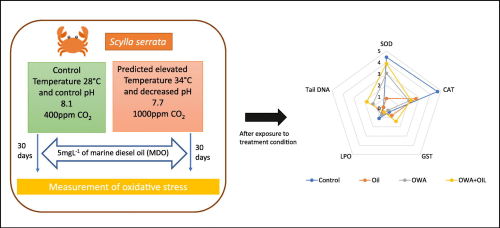
Highlights
- The OAW conditions reduce tolerance capacity of crabs to acute pollution stress.
- A greater degree of stress was experienced in oil exposure under OAW conditions.
- Augmented antioxidant and detoxification enzyme activity was noted.
Abstract
Anthropogenic activities primarily combustion of fossil fuel is the prime cause behind the increased concentration of CO2 into the atmosphere. As a consequence, marine environments are anticipated to experience shift towards lower pH and elevated temperatures. Moreover, since the industrial revolution the growing demand for petroleum-based products has been mounting up worldwide leading to severe oil pollution. Sundarbans estuarine system (SES) is experiencing ocean warming, acidification as well as oil pollution from the last couple of decades. Scylla serrata is one of the most commercially significant species for aquaculture in coastal areas of Sundarbans. Thus, the prime objective of this study is to delineate whether exposure under ocean warming and acidification exacerbates effect of oil spill on oxidative stress of an estuarine crab S. serrata. Animals were separately exposed under current and projected climate change scenario for 30 days. After this half animals of each treatment were exposed to oil spill conditions for 24 h. Oxidative stress status superoxide dismutase (SOD), catalase (CAT), glutathione S-transferase (GST), lipid peroxidation (LPO level) and DNA damage (Comet assay) were measured. Augmented antioxidant and detoxification enzyme activity was noted except for SOD but failed to counteract LPO and DNA damage. The present results clearly highlighted the detrimental combined effect of OWA and pollution on oxidative stress status of crabs that might potentially reduce its population and affect the coastal aquaculture in impending years.
Continue reading ‘The influence of ocean acidification and warming on responses of Scylla serrata to oil pollution: an integrated biomarker approach’

