Posts Tagged 'toxicants'


Transgenerational adaptation to ocean acidification determines the susceptibility of filter-feeding rotifers to nanoplastics

The adaptation of marine organisms to the impending challenges presented by ocean acidification (OA) is essential for their future survival, and mechanisms underlying OA adaptation have been reported in several marine organisms. In the natural environment, however, marine organisms are often exposed to a combination of environmental stressors, and the interactions between adaptive responses have yet to be elucidated. Here, we investigated the susceptibility of filter-feeding rotifers to short-term (ST) and long-term (LT) (≥180 generations) high CO2 conditions coupled with nanoplastic (NPs) exposure (ST+ and LT+). Adaptation of rotifers to elevated CO2 caused differences in ingestion and accumulation of NPs, resulting in a significantly different mode of action on in vivo endpoints between the ST+ and LT+ groups. Moreover, microRNA-mediated epigenetic regulation was strongly correlated with the varied adaptive responses between the ST+ and LT+ groups, revealing novel regulatory targets and pathways. Our results indicate that pre-exposure history to increased CO2 levels is an important factor in the susceptibility of rotifers to NPs.

Continue reading ‘Transgenerational adaptation to ocean acidification determines the susceptibility of filter-feeding rotifers to nanoplastics’

Elevated pCO2 alleviates the toxic effects of polystyrene nanoparticles on the marine microalga Nannochloropsis oceanica

Highlights

  • Inhibition of marine microalgae by polystyrene nanoparticles (100 nm) was evaluated.
  • Increased pCO2 mitigated growth inhibition of algal cells caused by polystyrene nanoparticles.
  • Polystyrene nanoparticles achieve inhibition effect by down-regulating key enzymes of TCA cycle.
  • Increased pCO2 mitigated the toxicity of polystyrene nanoparticles by upregulating ribosomes and corresponding synthesis processes.
  • Aggregation of polystyrene nanoparticles was detected in acidizing experimental medium.

Abstract

Concerns about the environmental effects of nanoplastics on marine ecosystems are increasing. Ocean acidification (OA) has also become a global environmental problem. Plastic pollution occurs concomitantly with anthropogenic climate stressors such as OA. However, the combined effects of NP and OA on marine phytoplankton are still not well understood. Therefore, we have investigated the behavior of ammonia (NH2) polystyrene nanoparticles (PS NP) in f/2 medium under 1000 μatm pCO2 and discussed the toxicity of PS NP (100 nm; 0.5 and 1.5 mg/L) on Nannochloropsis oceanica under long and short-term acidification (LA and SA; pCO2 ~ 1000 μatm). We observed PS NP suspended in pCO2 1000 μatm f/2 medium aggregated to a size greater than nanoscale (1339.00 ± 76.10 nm). In addition, we found that PS NP significantly inhibited the growth of N. oceanica at two concentrations, which also produced oxidative stress. Whereas, the growth of algal cells under the coupling of acidification and PS NP was significantly better than that of single PS NP exposure. This indicated that acidification significantly alleviated the toxic effects of PS NP on N. oceanica, and long-term acidification can even promote the growth of N. oceanica under low-density NP. To further understand the mechanism, we analyzed a comparative transcriptome. The results showed that PS NP exposure inhibited the expression of genes involved in the TCA cycle. The acidification was possibly reflected in ribosomes and corresponding processes, which alleviated the negative effects of PS NP on N. oceanica by promoting the synthesis of related enzymes and proteins. This study provided a theoretical basis for assessing the damage of NP to marine phytoplankton under OA. We propose that future studies evaluating the toxicology of NP to marine ecology should consider the changing ocean climate.

Continue reading ‘Elevated pCO2 alleviates the toxic effects of polystyrene nanoparticles on the marine microalga Nannochloropsis oceanica’

Global climate change increases the impact of pollutant mixtures in the model species Paracentrotus lividus

Highlights

  • Impact of chlorpyrifos (CPF) and microplastics (MP) on P. lividus is studied.
  • We also studied if climate change increases the toxicity of these pollutants.
  • CPF has a marked effect on growth of larvae, but less on the fertilisation rate.
  • MP increases the negative effect of CPF on growth and development.
  • Global climate change conditions increase the sensitivity of embryos to MP and CPF.

Abstract

The goal of the present work is to study whether ocean- acidification (OA) and -warming (OW) could increase the toxicity of pollutants on P. lividus. We studied how model pollutants such as chlorpyrifos (CPF) and microplastics (MP), alone or in combination, impact the fertilisation process, and the development of larvae under conditions of OA (dissolved inorganic carbon increase of 126 × 10−6 mol per kg of sea water) and OW (temperature increase of 4 °C) predicted by FAO (Food and Agriculture Organization) for the next 50 years. Fertilisation was determined by microscopic examination after 1 h. Growth, morphology, and alteration level were measured after 48 h of incubation. Results showed that CPF has a marked effect on the growth of larvae, but less on the fertilisation rate. When larvae are exposed to both MP and CPF, the effect on fertilisation and growth is higher than when CPF is added alone. Larvae exposed to CPF tend to adopt a rounded shape which is detrimental to their buoyancy and the combination with other stressors aggravate this situation. The variables most influenced by CPF or its mixtures are those related to body length, body width, and higher levels of body abnormalities, which is consistent with the degenerative effects caused by CPF on sea urchin larvae. The PCA analysis showed that temperature has more influence when embryos or larvae are exposed to a combination of stressors, demonstrating that global climate change drastically increase the impact of CPF on aquatic ecosystems. Overall, in this work we demonstrated that global climate change conditions increase the sensitivity of embryos to MP and CPF. Our findings support the idea that global change conditions could have a severe impact on marine life, increasing the negative effect of toxic agents commonly present in the sea and their mixtures.

Continue reading ‘Global climate change increases the impact of pollutant mixtures in the model species Paracentrotus lividus’

High and diurnally fluctuating carbon dioxide exposure produces lower mercury toxicity in a marine copepod

Highlights

  • Elevated pCO2 decreased Hg accumulation in Hg-treated T. japonicus.
  • Fluctuating elevated pCO2 further decreased Hg bioaccumulation.
  • Hg exposure caused energy depletion and oxidative stress in T. japonicus.
  • Elevated pCO2 initiated compensatory response in copepods to decrease Hg toxicity.
  • Fluctuating elevated pCO2 presented more immune defense related genes/processes.

Abstract

Coastal waters have experienced fluctuations in partial pressure of carbon dioxide (pCO2) and mercury (Hg) pollution, yet little is known concerning how natural pCO2 fluctuations affect Hg biotoxicity. Here, a marine copepod Tigriopus japonicus was interactively exposed to different seawater pCO2 (ambient 400, steady elevated 1000, and fluctuating elevated 1000 ± 600 μatm) scenarios and Hg (control, 2 μg/L) treatments for 7 d. The results showed that elevated pCO2 decreased Hg bioaccumulation, and it was even more under fluctuating elevated pCO2 condition. We found energy depletion and oxidative stress under Hg-treated copepods, while combined exposure initiated compensatory response to alleviate Hg toxicity. Intriguingly, fluctuating acidification presented more immune defense related genes/processes in Hg-treated copepods when compared to steady acidification, probably linking with the greater decrease in Hg bioaccumulation. Collectively, understanding how fluctuating acidification interacts with Hg contaminant will become more crucial in predicting their risks to coastal biota and ecosystems.

Continue reading ‘High and diurnally fluctuating carbon dioxide exposure produces lower mercury toxicity in a marine copepod’

Ocean warming and CO2-driven acidification can alter the toxicity of metal-contaminated sediments to the meiofauna community

Highlights

  • Contamination interacted with warming but the effect on density was taxon dependent.
  • Warming increased metal effects in nematods and copepods, and decreased in acoelomorphs.
  • Copepod densities were lower, and acoelomorphs higher, in the high CO2/low pH scenario.
  • Global change studies should consider multispecies exposures in multi-stressor scenarios.

Abstract

Interactive effects of trace metal contamination, ocean warming, and CO2-driven acidification on the structure of a meiofaunal benthic community was assessed. Meiofauna microcosm bioassays were carried out in controlled conditions in a full factorial experimental design which included three fixed factors: metal contamination in the sediment (3 levels of a mixture of Cu, Pb, Zn, and Hg), temperature (26 and 28 °C) and pH (7.6 and 8.1). Metal contamination caused a sharp decrease in the densities of the most abundant meiobenthic groups and interacted with temperature rise, exacerbating deleterious effects for Nematoda and Copepoda, but mitigating effects for Acoelomorpha. CO2-driven acidification resulted in increased acoelomorphs density, but only in sediments with lower levels of metals. Copepod densities, in turn, were lower in the CO2-driven acidification scenario regardless of contamination or temperature. The results obtained in the present study showed that temperature rise and CO2-driven acidification of coastal ocean waters, at environmentally relevant levels, interacts with trace metals in marine sediments, differently affecting the major groups of benthic biota.

Continue reading ‘Ocean warming and CO2-driven acidification can alter the toxicity of metal-contaminated sediments to the meiofauna community’

Combined effects of climate change and BDE-209 dietary exposure on the behavioural response of the white seabream, Diplodus sargus

Highlights

  • Fish were exposed to acidification, warming and BDE-209 via diet for 56 days.
  • BDE-209 lowered fish awareness of a risky situation and increased fish activity.
  • Interaction of BDE-209 with acidification and/or warming altered fish responses.
  • Acidification plus BDE-209 exposure increased fish anxiety and shoal cohesion.
  • Warming plus BDE-209 exposure increased anxiety and reversed fish lateralization.

Abstract

Decabromodiphenyl-ether (BDE-209) is a persistent organic pollutant ubiquitously found in marine environments worldwide. Even though this emerging chemical contaminant is described as highly toxic, bioaccumulative and biomagnifiable, limited studies have addressed the ecotoxicological implications associated with its exposure in non-target marine organisms, particularly from a behavioural standpoint. Alongside, seawater acidification and warming have been intensifying their impacts on marine ecosystems over the years, compromising species welfare and survival. BDE-209 exposure as well as seawater acidification and warming are known to affect fish behaviour, but information regarding their interactive effects is not available. In this study, long-term effects of BDE-209 contamination, seawater acidification and warming were studied on different behavioural traits of Diplodus sargus juveniles. Our results showed that D. sargus exhibited a marked sensitivity in all the behaviour responses after dietary exposure to BDE-209. Fish exposed to BDE-209 alone revealed lower awareness of a risky situation, increased activity, less time spent within the shoal, and reversed lateralization when compared to fish from the Control treatment. However, when acidification and/or warming were added to the equation, behavioural patterns were overall altered. Fish exposed to acidification alone exhibited increased anxiety, being less active, spending more time within the shoal, while presenting a reversed lateralization. Finally, fish exposed to warming alone were more anxious and spent more time within the shoal compared to those of the Control treatment. These novel findings not only confirm the neurotoxicological attributes of brominated flame retardants (like BDE-209), but also highlight the relevance of accounting for the effects of abiotic variables (e.g. pH and seawater temperature) when investigating the impacts of environmental contaminants on marine life.

Continue reading ‘Combined effects of climate change and BDE-209 dietary exposure on the behavioural response of the white seabream, Diplodus sargus’

Ocean acidification enhances the embryotoxicity of CuO nanoparticles to Oryzias melastigma

Concerns are raised towards individual effects of ocean acidification (OA) and engineered nanoparticles (NPs) on marine organisms. However, there are scarce studies regarding nanotoxicity under OA conditions. We investigated the combined effects of OA (pHs, 7.70 and 7.40) and CuO NPs on the embryotoxicity of marine medaka Oryzias melastigma and the bioavailability of CuO NPs in embryos. The results showed that OA alleviated the aggregation of CuO NPs and promoted the dissolution of CuO NPs in seawater (increased by 0.010 and 0.029 mg/L under pHs 7.70 and 7.40, respectively). Synergistic effects of OA with CuO NPs on medaka embryos were observed as indicated by much higher mortality and oxidative damage. Importantly, the enhanced toxicity of CuO NPs to medaka embryos under OA conditions mainly originated from the higher bioavailability of particulate CuO (e.g., 30.28 mg/kg at pH 7.40) rather than their released Cu2+ ions (e.g. 3.04 mg/kg at pH 7.40). The weaker aggregation of NPs under OA conditions resulted in higher penetration of individual particles (or small aggregates) into embryos through the micropyle and chorionic pores, causing enhanced bioavailability of NPs. The obtained results provided underlying insights into understanding the risk of NPs to marine ecosystem under OA conditions.

Continue reading ‘Ocean acidification enhances the embryotoxicity of CuO nanoparticles to Oryzias melastigma’

Effect of ocean acidification on the growth, response and hydrocarbon degradation of coccolithophore-bacterial communities exposed to crude oil

Hydrocarbon-degrading bacteria, which can be found living with eukaryotic phytoplankton, play a pivotal role in the fate of oil spillage to the marine environment. Considering the susceptibility of calcium carbonate-bearing phytoplankton under future ocean acidification conditions and their oil-degrading communities to oil exposure under such conditions, we investigated the response of non-axenic E. huxleyi to crude oil under ambient versus elevated CO2 concentrations. Under elevated CO2 conditions, exposure to crude oil resulted in the immediate decline of E. huxleyi, with concomitant shifts in the relative abundance of Alphaproteobacteria and Gammaproteobacteria. Survival of E. huxleyi under ambient conditions following oil enrichment was likely facilitated by enrichment of oil-degraders Methylobacterium and Sphingomonas, while the increase in relative abundance of Marinobacter and unclassified Gammaproteobacteria may have increased competitive pressure with E. huxleyi for micronutrient acquisition. Biodegradation of the oil was not affected by elevated CO2 despite a shift in relative abundance of known and putative hydrocarbon degraders. While ocean acidification does not appear to affect microbial degradation of crude oil, elevated mortality responses of E. huxleyi and shifts in the bacterial community illustrates the complexity of microalgal-bacterial interactions and highlights the need to factor these into future ecosystem recovery projections.

Continue reading ‘Effect of ocean acidification on the growth, response and hydrocarbon degradation of coccolithophore-bacterial communities exposed to crude oil’

In vivo mercury (de)methylation metabolism in cephalopods under different pCO2 scenarios

This work quantified the accumulation efficiencies of Hg in cuttlefish, depending on both organic (MeHg) and inorganic (Hg(II)) forms, under increased pCO2 (1600 μatm). Cuttlefish were fed with live shrimps injected with two Hg stable isotopic tracers (Me202Hg and 199Hg(II)), which allowed for the simultaneous quantification of internal Hg accumulation, Hg(II) methylation, and MeHg demethylation rates in different organs. Results showed that pCO2 had no impact on Hg bioaccumulation and organotropism, and both Hg and pCO2 did not influence the microbiota diversity of gut and digestive gland. However, the results also demonstrated that the digestive gland is a key organ for in vivo MeHg demethylation. Consequently, cuttlefish exposed to environmental levels of MeHg could exhibit in vivo MeHg demethylation. We hypothesize that in vivo MeHg demethylation could be due to biologically induced reactions or to abiotic reactions. This has important implications as to how some marine organisms may respond to future ocean change and global mercury contamination.

Continue reading ‘In vivo mercury (de)methylation metabolism in cephalopods under different pCO2 scenarios’

Review of warming and acidification effects to the ecotoxicity of pharmaceuticals on aquatic organisms in the era of climate change

Highlights

  • Acidification and warming modulates the ecotoxicity of pharmaceuticals.
  • Biochemical, cellular and behavioral biomarkers show a response.
  • Trends of change in acute and chronic toxicity were drug dependent.
  • Acidification modified the toxicity of selected ionizable pharmaceuticals.
  • Bioaccumulation was modified by target effects of global warming.

Abstract

An increase in the temperature and the acidification of the aquatic environment are among the many consequences of global warming. Climate change can also negatively affect aquatic organisms indirectly, by altering the toxicity of pollutants. Models of climate change impacts on the distribution, fate and ecotoxicity of persistent pollutants are now available. For pharmaceuticals, however, as new environmental pollutants, there are no predictions on this issue. Therefore, this paper organizes the existing knowledge on the effects of temperature, pH and both stressors combined on the toxicity of pharmaceuticals on aquatic organisms. Besides lethal toxicity, the molecular, physiological and behavioral biomarkers of sub-lethal stress were also assessed. Both acute and chronic toxicity, as well as bioaccumulation, were found to be affected. The direction and magnitude of these changes depend on the specific pharmaceutical, as well as the organism and conditions involved. Unfortunately, the response of organisms was enhanced by combined stressors. We compare the findings with those known for persistent organic pollutants, for which the pH has a relatively low effect on toxicity. The acid-base constant of molecules, as assumed, have an effect on the toxicity change with pH modulation. Studies with bivalves have been were overrepresented, while too little attention was paid to producers. Furthermore, the limited number of pharmaceuticals have been tested, and metabolites skipped altogether. Generally, the effects of warming and acidification were rather indicated than explored, and much more attention needs to be given to the ecotoxicology of pharmaceuticals in climate change conditions.

Continue reading ‘Review of warming and acidification effects to the ecotoxicity of pharmaceuticals on aquatic organisms in the era of climate change’

Ocean acidification induces tissue-specific interactions with copper toxicity on antioxidant defences in viscera and gills of Asiatic hard clam Meretrix petechialis (Lamarck, 1818)

Highlights

  • Cu and OA coexposures induce tissue-specific oxidative stress in clams.
  • OA exacerbates Cu toxicity and increases oxidative damage in tissues.
  • Gill is more vulnerable to oxidation than viscera with MDA and 8-OHdG as indicators.
  • PCAs usefully identify the contributions of biomarkers to antioxidant defences.
  • The results provide insights for assessing Cu toxicity under OA in wild bivalves.

Abstract

Toxicity of contaminants in organisms under ocean acidification (OA) has attracted increasing attention in ecotoxicological studies. This study investigated how pCO2-driven OA affected waterborne copper (Cu) toxicity in antioxidant defences in viscera and gills of Asiatic hard clam Meretrix petechialis (Lamarck, 1818). Clams were continuously exposed to Cu at ambient relevant (0/no metal exposure, 10 and 50 μg L−1) and polluted-high (100 μg L−1) concentrations in unacidified (pH 8.10) and acidified (pH 7.70/moderate OA and 7.30/extreme OA) seawater for 21 days. Following coexposure, metal bioaccumulation and responses of antioxidant defence-related biomarkers to OA and Cu coexposure were investigated. Results showed that metal bioaccumulation was positively correlated with waterborne metal concentrations but was not notably influenced by OA conditions. Both Cu and OA affected the antioxidant responses to environmental stress. Additionally, OA induced tissue-specific interactions with Cu on antioxidant defences, varying with exposure conditions. In unacidified seawater, antioxidant biomarkers were activated to defend against oxidative stress induced by Cu and prevented clams from lipid peroxidation (LPO or MDA), but failed to defend against DNA damage (8-OHdG). OA exacerbated Cu toxicity in antioxidant defences and increased LPO levels in tissues. Gills and viscera adopted adaptive antioxidant defence strategies to manage oxidative stress, with the former being more vulnerable to oxidative stress than the latter. MDA and 8-OHdG were sensitive to OA and Cu exposure, respectively, and were useful bioindicators for assessing oxidative stress. Integrated biomarker response (IBR) and PCA can reflect the integrative responses of antioxidant biomarkers to environmental stress and illuminate the contributions of specific biomarkers to antioxidant defence strategies. The findings provided insights for understanding antioxidant defences against metal toxicity in marine bivalves under OA scenarios, which is essential into managing wild populations.

Continue reading ‘Ocean acidification induces tissue-specific interactions with copper toxicity on antioxidant defences in viscera and gills of Asiatic hard clam Meretrix petechialis (Lamarck, 1818)’

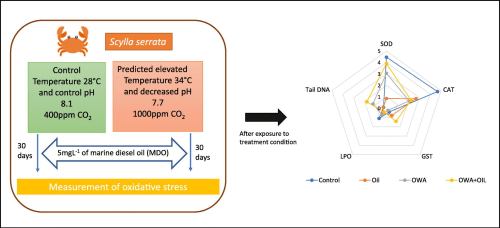
The influence of ocean acidification and warming on responses of Scylla serrata to oil pollution: an integrated biomarker approach

Graphical abstract

Highlights

  • The OAW conditions reduce tolerance capacity of crabs to acute pollution stress.
  • A greater degree of stress was experienced in oil exposure under OAW conditions.
  • Augmented antioxidant and detoxification enzyme activity was noted.

Abstract

Anthropogenic activities primarily combustion of fossil fuel is the prime cause behind the increased concentration of CO2 into the atmosphere. As a consequence, marine environments are anticipated to experience shift towards lower pH and elevated temperatures. Moreover, since the industrial revolution the growing demand for petroleum-based products has been mounting up worldwide leading to severe oil pollution. Sundarbans estuarine system (SES) is experiencing ocean warming, acidification as well as oil pollution from the last couple of decades. Scylla serrata is one of the most commercially significant species for aquaculture in coastal areas of Sundarbans. Thus, the prime objective of this study is to delineate whether exposure under ocean warming and acidification exacerbates effect of oil spill on oxidative stress of an estuarine crab S. serrata. Animals were separately exposed under current and projected climate change scenario for 30 days. After this half animals of each treatment were exposed to oil spill conditions for 24 h. Oxidative stress status superoxide dismutase (SOD), catalase (CAT), glutathione S-transferase (GST), lipid peroxidation (LPO level) and DNA damage (Comet assay) were measured. Augmented antioxidant and detoxification enzyme activity was noted except for SOD but failed to counteract LPO and DNA damage. The present results clearly highlighted the detrimental combined effect of OWA and pollution on oxidative stress status of crabs that might potentially reduce its population and affect the coastal aquaculture in impending years.

Continue reading ‘The influence of ocean acidification and warming on responses of Scylla serrata to oil pollution: an integrated biomarker approach’

Nanoplastics induce epigenetic signatures of transgenerational impairments associated with reproduction in copepods under ocean acidification

Graphical abstract

Ocean acidification (OA) is one of many major global climate changes that pose a variety of risks to marine ecosystems in different ways. Meanwhile, there is growing concern about how nanoplastics (NPs) affect marine ecosystems. Combined exposure of marine organisms to OA and NPs is inevitable, but their interactive effects remain poorly understood. In this study, we investigated the multi- and transgenerational toxicity of NPs on copepods under OA conditions for ten generations. The findings revealed that OA and NPs have a synergistic negative effect on copepod reproduction across generations. In particular, the transgenerational groups showed reproductive impairments in the F1 and F2 generations (F1T and F2T), even though they were never exposed to NPs. Moreover, our epigenetic examinations demonstrated that the observed intergenerational reproductive impairments are associated with differential methylation patterns of specific genes, suggesting that the interaction of OA and NPs can pose a significant threat to the sustainability of copepod populations through epigenetic modifications. Overall, our findings provide valuable insight into the intergenerational toxicity and underlying molecular mechanisms of responses to NPs under OA conditions.

Continue reading ‘Nanoplastics induce epigenetic signatures of transgenerational impairments associated with reproduction in copepods under ocean acidification’

Predicting effects of multiple interacting global change drivers across trophic levels

Global change encompasses many co-occurring anthropogenic drivers, which can act synergistically or antagonistically on ecological systems. Predicting how different global change drivers simultaneously contribute to observed biodiversity change is a key challenge for ecology and conservation. However, we lack the mechanistic understanding of how multiple global change drivers influence the vital rates of multiple interacting species. We propose that reaction norms, the relationships between a driver and vital rates like growth, mortality, and consumption, provide insights to the underlying mechanisms of community responses to multiple drivers. Understanding how multiple drivers interact to affect demographic rates using a reaction-norm perspective can improve our ability to make predictions of interactions at higher levels of organization—that is, community and food web. Building on the framework of consumer–resource interactions and widely studied thermal performance curves, we illustrate how joint driver impacts can be scaled up from the population to the community level. A simple proof-of-concept model demonstrates how reaction norms of vital rates predict the prevalence of driver interactions at the community level. A literature search suggests that our proposed approach is not yet used in multiple driver research. We outline how realistic response surfaces (i.e., multidimensional reaction norms) can be inferred by parametric and nonparametric approaches. Response surfaces have the potential to strengthen our understanding of how multiple drivers affect communities as well as improve our ability to predict when interactive effects emerge, two of the major challenges of ecology today.

Continue reading ‘Predicting effects of multiple interacting global change drivers across trophic levels’

Ocean acidification-mediated food chain transfer of polonium between primary producers and consumers

Phytoplankton and zooplankton are key marine components that play an important role in metal distribution through a food web transfer. An increased phytoplankton concentration as a result of ocean acidification and warming are well-established, along with the fact that phytoplankton biomagnify 210Po by 3–4 orders of magnitude compared to the seawater concentration. This experimental study is carried out to better understand the transfer of polonium between primary producers and consumers. The experimental produced data highlight the complex interaction between the polonium concentration in zooplankton food, i.e. phytoplankton, its excretion via defecated fecal pellets, and its bioaccumulation at ambient seawater pH and a lower pH of 7.7, typical of ocean acidification scenarios in the open ocean. The mass of copepods recovered was 11% less: 7.7 pH compared to 8.2. The effects of copepod species (n = 3), microalgae species (n = 3), pH (n = 2), and time (n = 4) on the polonium activity in the fecal pellets (expressed as % of the total activity introduced through feeding) was tested using an ANOVA 4. With the exception of time (model: F20, 215 = 176.84, p < 0.001; time: F3 = 1.76, p = 0.16), all tested parameters had an impact on the polonium activity (copepod species: F2 = 169.15, p < 0.0001; algae species: F2 = 10.21, p < 0.0001; pH: F1 = 9.85, p = 0.002) with complex interactions (copepod x algae: F2 = 19.48, p < 0.0001; copepod x pH: F2 = 10.54, p < 0.0001; algae x pH: F2 = 4.87, p = 0.009). The experimental data underpin the hypothesis that metal bioavailability and bioaccumulation will be enhanced in secondary consumers such as crustacean zooplankton due to ocean acidification.

Continue reading ‘Ocean acidification-mediated food chain transfer of polonium between primary producers and consumers’

Antagonism toxicity of CuO nanoparticles and mild ocean acidification to marine algae

Graphical abstract

The toxicity of CuO nanoparticles (NPs) to marine microalgae (Emiliania huxleyi) under ocean acidification (OA) conditions (pHs 8.10, 7.90, 7.50) was investigated. CuO NPs (5.0 mg/L) caused significant toxicity (e.g., 48-h growth inhibition, 20%) under normal pH (8.10), and severe OA (pH 7.50) increased the toxicity of CuO NPs (e.g., 48-h growth inhibition, 68%). However, toxicity antagonism was observed with a growth inhibition (48 h) decreased to 37% after co-exposure to CuO NPs and mild OA (pH 7.90), which was attributed to the released Cu2+ ions from CuO NPs. Based on biological responses as obtained from RNA-sequencing, the dissolved Cu2+ ions (0.078 mg/L) under mild OA were found to increase algae division (by 17%) and photosynthesis (by 28%) through accelerating photosynthetic electron transport and promoting ATP synthesis. In addition, mild OA enhanced EPS secretion by 41% and further increased bioavailable Cu2+ ions, thus mitigating OA-induced toxicity. In addition, excess Cu2+ ions could be transformed into less toxic Cu2S and Cu2O based on X-ray absorption near-edge spectroscopy (XANES) and high-resolution transmission electron microscopy (HR-TEM), which could additionally regulate the antagonism effect of CuO NPs and mild OA. The information advances our knowledge in nanotoxicity to marine organisms under global climate change.

Continue reading ‘Antagonism toxicity of CuO nanoparticles and mild ocean acidification to marine algae’

Elevated CO2 reduces copper accumulation and toxicity in the diatom Thalassiosira pseudonana

The projected ocean acidification (OA) associated with increasing atmospheric CO2 alters seawater chemistry and hence the bio-toxicity of metal ions. However, it is still unclear how OA might affect the long-term resilience of globally important marine microalgae to anthropogenic metal stress. To explore the effect of increasing pCO2 on copper metabolism in the diatom Thalassiosira pseudonana (CCMP 1335), we employed an integrated eco-physiological, analytical chemistry, and transcriptomic approach to clarify the effect of increasing pCO2 on copper metabolism of Thalassiosira pseudonana across different temporal (short-term vs. long-term) and spatial (indoor laboratory experiments vs. outdoor mesocosms experiments) scales. We found that increasing pCO2 (1,000 and 2,000 μatm) promoted growth and photosynthesis, but decreased copper accumulation and alleviated its bio-toxicity to T. pseudonana. Transcriptomics results indicated that T. pseudonana altered the copper detoxification strategy under OA by decreasing copper uptake and enhancing copper-thiol complexation and copper efflux. Biochemical analysis further showed that the activities of the antioxidant enzymes glutathione peroxidase (GPX), catalase (CAT), and phytochelatin synthetase (PCS) were enhanced to mitigate oxidative damage of copper stress under elevated CO2. Our results provide a basis for a better understanding of the bioremediation capacity of marine primary producers, which may have profound effect on the security of seafood quality and marine ecosystem sustainability under further climate change.

Continue reading ‘Elevated CO2 reduces copper accumulation and toxicity in the diatom Thalassiosira pseudonana’

Charge-dependent negative effects of polystyrene nanoplastics on Oryzias melastigma under ocean acidification conditions

Graphical abstract.

Highlights

  • PS-NH2 exhibited more aggregation than PS-COOH in acidified seawater.
  • Ocean acidification reversed toxicity of positively and negatively charged NPs.
  • Ocean acidification reversed the internalization of PS-NH2 and PS-COOH.
  • PS-NPs at environmental level could transfer from embryos to larvae.

Abstract

Marine nanoplastics (NPs) have attracted increasing global attentions because of their detrimental effects on marine environments. A co-existing major environmental concern is ocean acidification (OA). However, the effects of differentially charged NPs on marine organisms under OA conditions are poorly understood. We therefore investigated the effects of OA on the embryotoxicity of both positively and negatively charged polystyrene (PS) NPs to marine medaka (Oryzias melastigma). Positively charged PS-NH2 exhibited slighter aggregation under normal conditions and more aggregation under OA conditions than negatively charged PS-COOH. According to the integrated biomarker approach, OA reversed the toxicity of positively and negatively charged NPs towards embryos. Importantly, at environmental relevant concentrations, both types of PS-NPs could enter the embryos through chorionic pores and then transfer to the larvae. OA reversed the internalization of PS-NH2 and PS-COOH in O. melastigma. Overall, the reversed toxicity of PS-NH2 and PS-COOH associated with OA could be caused by the reversed bioavailability of NPs to O. melastigma, which was attributed to altered aggregation of the NPs in acidified seawater. This finding demonstrates the charge-dependent toxicity of NPs to marine fish and provides new insights into the potential hazard of NPs to marine environments under OA conditions that could be encountered in the near future.

Continue reading ‘Charge-dependent negative effects of polystyrene nanoplastics on Oryzias melastigma under ocean acidification conditions’

Global decrease in heavy metal concentrations in brown algae in the last 90 years

Graphical abstract

Highlights

  • A decline in metal pollution in algae is widespread in coastal ecosystems worldwide.
  • Decrease in algae concentrations may not also occur in seawater but in bioavailability.
  • Decreases began from 70’s coinciding with the implementation of environmental policies.
  • Legislation and ocean acidification can impact on the heavy metal content in algae.

Abstract

In the current scenario of global change, heavy metal pollution is of major concern because of its associated toxic effects and the persistence of these pollutants in the environment. This study is the first to evaluate the changes in heavy metal concentrations worldwide in brown algae over the last 90 years (>15,700 data across the globe reported from 1933 to 2020). The study findings revealed significant decreases in the concentrations of Cd, Co, Cr, Cu, Fe, Hg, Mn, Pb and Zn of around 60–84% (ca. 2% annual) in brown algae tissues. The decreases were consistent across the different families considered (Dictyotaceae, Fucaceae, Laminariaceae, Sargassaceae and Others), and began between 1970 and 1990. In addition, strong relationships between these trends and pH, SST and heat content were detected. Although the observed metal declines could be partially explained by these strong correlations, or by adaptions in the algae, other evidences suggest an actual reduction in metal concentrations in oceans because of the implementation of environmental policies. In any case, this study shows a reduction in metal concentrations in brown algae over the last 50 years, which is important in itself, as brown algae form the basis of many marine food webs and are therefore potential distributors of pollutants.

Continue reading ‘Global decrease in heavy metal concentrations in brown algae in the last 90 years’

Sex and gametogenesis stage are strong drivers of gene expression in Mytilus edulis exposed to environmentally relevant plasticiser levels and pH 7.7

Plastic pollution and changes in oceanic pH are both pressing environmental issues. Little emphasis, however, has been placed on the influence of sex and gametogenesis stage when investigating the effects of such stressors. Here, we examined histology and molecular biomarkers of blue mussels Mytilus edulis exposed for 7 days to a pH 7.7 scenario (− 0.4 units) in combination with environmentally relevant concentrations (0, 0.5 and 50 µg/L) of the endocrine disrupting plasticiser di-2-ethylhexyl phthalate (DEHP). Through a factorial design, we investigated the gametogenesis cycle and sex-related expression of genes involved in pH homeostasis, stress response and oestrogen receptor-like pathways after the exposure to the two environmental stressors. As expected, we found sex-related differences in the proportion of developing, mature and spawning gonads in histological sections. Male gonads also showed higher levels of the acid–base regulator CA2, but females had a higher expression of stress response-related genes (i.e. sod, cat, hsp70). We found a significant effect of DEHP on stress response-related gene expression that was dependent on the gametogenesis stage, but there was only a trend towards downregulation of CA2 in response to pH 7.7. In addition, differences in gene expression between males and females were most pronounced in experimental conditions containing DEHP and/or acidified pH but never the control, indicating that it is important to consider sex and gametogenesis stage when studying the response of mussels to diverse stressors.

Continue reading ‘Sex and gametogenesis stage are strong drivers of gene expression in Mytilus edulis exposed to environmentally relevant plasticiser levels and pH 7.7′

Subscribe

Search

  • Reset

OA-ICC Highlights

Resources