Archive Page 246

Opening for graduate research assistant in ocean acidification

The Ocean Acidification Research Center is seeking a current UAF graduate student for a research assistantship during the fall 2021 semester. The research assistant will be responsible for assisting with seawater sample analyses.

The RA contract is from Aug. 15 to Dec. 18, will cover tuition (< 9 credits), insurance and fees.The RA will work in the OARC 20 hours per week, preferably four to five hours per day. Students from any department with analytical chemistry experience are preferred, and interest in oceanography is desirable. Duties will include running instrumentation with supervision, solution preparation, data input, and bottle washing.

Email Natalie Monacci at nmonacci@alaska.edu by June 1 for details.

Continue reading ‘Opening for graduate research assistant in ocean acidification’

Assistant or associate professor: ecosystem oceanographer

Position Details

Department: Earth, Ocean & Atmo Sci (OAS)

Position Title: Assistant Professor

Job Title: Assistant or Associate Professor: Ecosystem Oceanographer

Appointment Type: Academic Teaching/Research Faculty

Job Location: Newport

Position Summary:

The College of Earth, Ocean and Atmospheric Sciences invites applications for a full-time (.75 FTE), 12-month, Tenure Track (Annual) Assistant or Associate Professor Ecosystem Oceanographer position.This new position is for an Ecosystem Oceanographer who will take full advantage of unique OSU and NOAA resources and collaborative opportunities at the Hatfield Marine Science Center in Newport, Oregon.The successful applicant will have the necessary expertise to examine the role of physical and biogeochemical ocean processes in population dynamics, recruitment, survival, and adaptation of managed and protected marine species. This position is co-sponsored by the NOAA Estuarine and Ocean Ecology (EOE) program and will have the academic home in the College of Earth, Ocean, and Atmospheric Sciences (CEOAS) of Oregon State University. This position will also receive support during the first 5 years from the Marine Studies Initiative. For academic-track positions, it is CEOAS policy to hire as a 12-month, 0.75 FTE (equivalent to the traditional 9-month 1.0 FTE) and confer indefinite tenure when promoted to Associate Professor.

Continue reading ‘Assistant or associate professor: ecosystem oceanographer’

Helen Gurney-Smith | how will climate change affect key species?

Date: May 17, 2021

Time: 2:00 pm to 2:45 pm EST

Climate change is affecting marine life, including where species live and how they are responding to changes in their environment. Marine species are not only fascinating, but they also provide us with important sources of food and support coastal economies and communities. To find out how climate change may affect lobsters, Research Scientist Helen Gurney-Smith and her team in Fisheries and Oceans Canada conduct laboratory experiments using predicted climate conditions of warmer waters and lowered pH (ocean acidification). This talk will be about climate change in marine ecosystems, lobsters, how we conduct the experiments and what it means for lobster adults, embryos and juveniles.

Continue reading ‘Helen Gurney-Smith | how will climate change affect key species?’

UN World Ocean Day 2021

The United Nations celebrates World Ocean Day on June 8.  This year’s UN WOD theme is The Ocean: Life & Livelihoods.  
 
During this year’s UN World Ocean Day, we have an opportunity to increase global ambition for actions that reduce the causes and impacts of climate-ocean change–including actions that support food security and sovereignty, increase resilience of marine ecosystems and build a sustainable ocean economy.  This is reflected in the UN Sustainable Development Goal Agenda and target SDG 14.3, to “Minimize and address the impacts of ocean acidification.”

Date: 8 June 2021

Link: Implementing UN SDG 14.3 – Protecting Communities and Livelihoods from the Threat of a Changing Ocean – UN World Oceans Day

Time: 12 pm Pacific Time (US and Canada)

Registration: Webinar Registration – Zoom

Title: Implementing UN SDG 14.3 – protecting communities and livelihoods from the threat of a changing ocean

In 2021, it is imperative that governments and civil society continue to advance the suite of science and policy actions that will be needed to support food security and sovereignty, increase resilience of marine ecosystems and build a sustainable ocean economy in the face of future change. This is reflected in the UN Sustainable Development Goal Agenda and target SDG 14.3, to “Minimize and address the impacts of ocean acidification”.

As the science, research and observed impacts of ocean acidification continue to grow, there is a continued need for increased knowledge exchange and expertise on the substance and process for developing local, regional and national responses in the face of cumulative ocean change.

60 minutes

Hello and Introduction of Agenda:

Jessie Turner, OA Alliance and Alexis Valauri-Orton, The Ocean Foundation

Ocean Acidification Poetry: Samantha Jones

Opening Remarks: United Nations Secretary-General’s Special Envoy for the Ocean Ambassador Peter Thomson

Actions to Address OA and Implement SDG 14.3 From Around the World (invited speakers)

Closing Remarks:   Dr. Peter Swarzenski, International Atomic Energy Agency (IAEA) OA International Coordination Centre

Continue reading ‘UN World Ocean Day 2021’

A dynamic stress-scape framework to evaluate potential effects of multiple environmental stressors on Gulf of Alaska juvenile Pacific cod

Quantifying the spatial and temporal footprint of multiple environmental stressors on marine fisheries is imperative to understanding the effects of changing ocean conditions on living marine resources. Pacific Cod (Gadus macrocephalus), an important marine species in the Gulf of Alaska ecosystem, has declined dramatically in recent years, likely in response to extreme environmental variability in the Gulf of Alaska related to anomalous marine heatwave conditions in 2014–2016 and 2019. Here, we evaluate the effects of two potential environmental stressors, temperature variability and ocean acidification, on the growth of juvenile Pacific Cod in the Gulf of Alaska using a novel machine-learning framework called “stress-scapes,” which applies the fundamentals of dynamic seascape classification to both environmental and biological data. Stress-scapes apply a probabilistic self-organizing map (prSOM) machine learning algorithm and Hierarchical Agglomerative Clustering (HAC) analysis to produce distinct, dynamic patches of the ocean that share similar environmental variability and Pacific Cod growth characteristics, preserve the topology of the underlying data, and are robust to non-linear biological patterns. We then compare stress-scape output classes to Pacific Cod growth rates in the field using otolith increment analysis. Our work successfully resolved five dynamic stress-scapes in the coastal Gulf of Alaska ecosystem from 2010 to 2016. We utilized stress-scapes to compare conditions during the 2014–2016 marine heatwave to cooler years immediately prior and found that the stress-scapes captured distinct heatwave and non-heatwave classes, which highlighted high juvenile Pacific Cod growth and anomalous environmental conditions during heatwave conditions. Dominant stress-scapes underestimated juvenile Pacific Cod growth across all study years when compared to otolith-derived field growth rates, highlighting the potential for selective mortality or biological parameters currently missing in the stress-scape model as well as differences in potential growth predicted by the stress-scape and realized growth observed in the field. A sensitivity analysis of the stress-scape classification result shows that including growth rate data in stress-scape classification adjusts the training of the prSOM, enabling it to distinguish between regions where elevated sea surface temperature is negatively impacting growth rates. Classifications that rely solely on environmental data fail to distinguish these regions. With their incorporation of environmental and non-linear physiological variables across a wide spatio-temporal scale, stress-scapes show promise as an emerging methodology for evaluating the response of marine fisheries to changing ocean conditions in any dynamic marine system where sufficient data are available.

Continue reading ‘A dynamic stress-scape framework to evaluate potential effects of multiple environmental stressors on Gulf of Alaska juvenile Pacific cod’

Polar ocean acidification

Ocean

Fish stocks such as cod are much more negatively affected by changes in the polar oceans at 2°C global warming than at 1.5°C global warming. These changes include ocean acidification, warmer and less salty sea water from increased river runoff, glacier melt and ice sheet melt; as well as greater competition from mid-latitude species moving polewards. In contrast, polar species and ecosystems have nowhere further to migrate.

Today’s rates of ocean acidification are greater than at any time in 3 million years, and pose an immediate and serious threat in cold polar waters, which absorb CO2 more quickly. The oceans will need 50–70,000 years to return to normal pH levels, a key argument for keeping CO2 levels as low as possible and against schemes aiming to decrease solar radiation rather than CO2.

Continue reading ‘Polar ocean acidification’

Teaching ocean acidification

masthead background

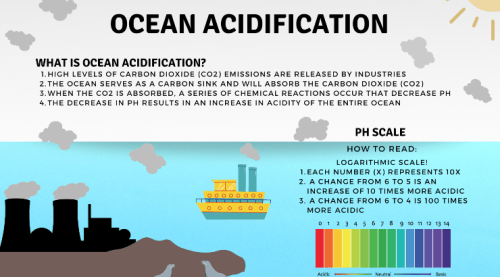
Ocean acidification is a phenomenon that results from increasing anthropogenic carbon dioxide emissions on land. As carbon dioxide is absorbed, a series of chemical reactions causes an increase in acidity. This leads to many detrimental effects on marine organisms reverberate up the food chain. One reason ocean acidification remains a grand challenge is because of how difficult it is to communicate to a general population. We prepared a lesson for a local APES class regarding ocean acidification hoping to influence young minds to become interested in this challenge. Our group also made an infographic to communicate ocean acidification in a simple way while conveying there is a potential solution.

Teaching Ocean Acidification Poster

Ocean Acidification Slideshow

Infographic

Continue reading ‘Teaching ocean acidification’

Carbonate chemistry seasonality in a tropical mangrove lagoon in La Parguera, Puerto Rico

We investigated the seasonal carbonate chemistry variability within a semi-enclosed tropical mangrove lagoon in southwestern Puerto Rico. Biweekly measurements of seawater temperature, salinity, total alkalinity (TA), and dissolved inorganic carbon (DIC) were conducted from 2014 to 2018. We describe the possible mechanisms driving the observed variability by correlating the DIC/TA ratio with pH and Ωarg, suggesting that the mean pH (7.87 ± 0.09) and aragonite saturation state (Ωarg, 2.96 ± 0.47) of the mangrove lagoon negatively affected calcification. The measured pCO2 and DIC/TA ratios indicate that heterotrophic activity was the primary driver for persistent acidification, which reached its maximum expression during the wet season. We conclude that mangrove lagoons with limited seawater exchange and high carbon input will not mitigate ocean acidification.

Continue reading ‘Carbonate chemistry seasonality in a tropical mangrove lagoon in La Parguera, Puerto Rico’

Calcium carbonate dissolution patterns in the ocean

Calcium carbonate (CaCO3) minerals secreted by marine organisms are abundant in the ocean. These particles settle and the majority dissolves in deeper waters or at the seafloor. Dissolution of carbonates buffers the ocean, but the vertical and regional distribution and magnitude of dissolution are unclear. Here we use seawater chemistry and age data to derive pelagic CaCO3 dissolution rates in major oceanic regions and provide the first data-based, regional profiles of CaCO3 settling fluxes. We find that global CaCO3 export at 300 m depth is 76 ± 12 Tmol yr−1, of which 36 ± 8 Tmol (47%) dissolves in the water column. Dissolution occurs in two distinct depth zones. In shallow waters, metabolic CO2 release and high-magnesium calcites dominate dissolution while increased CaCO3 solubility governs dissolution in deeper waters. Based on reconstructed sinking fluxes, our data indicate a higher CaCO3 transfer efficiency from the surface to the seafloor in high-productivity, upwelling areas than in oligotrophic systems. These results have implications for assessments of future ocean acidification as well as palaeorecord interpretations, as they demonstrate that surface ecosystems, not only interior ocean chemistry, are key to controlling the dissolution of settling CaCO3 particles.

Continue reading ‘Calcium carbonate dissolution patterns in the ocean’

A guide to climate tipping points: the oceans

Making sense of a world on edge

Image Credit: Environmental Defense Fund

3. The Oceans

In addition to local effects experienced in the Arctic and Antarctic, the oceans are heating and absorbing more CO2 on a global scale. This drives cascading effects on marine life and, to a lesser extent, methane deposits, both of which drive further emissions of greenhouse gases.

How is it affected by climate change? The marine carbon pump is being disrupted by climate change in multiple ways. As the ocean absorbs more CO2 from the atmosphere, increasing concentrations of primary producer algae have been observed. However, rising temperatures are also causing the ocean to acidify, making algae less effective at storing carbon and making calcifying organisms like corals and certain phytoplankton less effective at maintaining their skeletons (see #3.2). Lastly, disruption to thermohaline circulation could reduce the extent to which primary producers at the surface receive essential nutrients and circulate carbon to deeper levels (see #1.3 and #2.2).

What are the tipping points? Multiple potential tipping points have been predicted. One threshold could occur when primary producer populations shift from large diatoms to small-celled flagellates and cyanobacteria, diminishing energy transferred to the rest of the food web. Another would occur if the ocean becomes undersaturated in calcium carbonate, accelerating acidification and reducing the viability of calcifying organisms.

What is the timeline? The extent and timescale of these thresholds are uncertain. A tipping point for ocean acidification has been predicted at 450 ppm of atmospheric CO2 (2 °C global increase).

Continue reading ‘A guide to climate tipping points: the oceans’

Time running out to save coral reefs

The window of opportunity to save the world’s coral reefs is still open but time is running out. A new study by an international group of scientists, including UvA marine biologists Dr Verena Schoepf and Niklas Kornder, has calculated how coral reef growth is likely to react to ocean acidification and warming under three different climate-change carbon dioxide scenarios: low, medium and worst-case. The study, just published in the journal PNAS, has some good news to offer amid a grim outlook.

Picture: Verena Schoepf

‘If the world can reduce carbon dioxide emissions drastically, coral-reef growth will be reduced, but many reefs will still be able to grow,’ says lead author Dr Christopher Cornwall, from the Victoria University of Wellington, New Zealand. ‘Some of them will even keep pace with sea-level rise. Even if we fail with those drastic reductions but do keep within the intermediate emissions scenario, some coral reefs will still keep growing for a short while, but by the end of the century they will all be eroding. If we hit the worst-case scenario, then very shortly all coral reefs will be eroding.’

Impact of climate change

The research by academics in New Zealand, Australia, the United States, France, The Netherlands and the United Kingdom breaks new ground.The interdisciplinary group of scientists formed initially as a working group led by the Australian Research Council’s Centre of Excellence for Coral Reef Studies in 2016. There has been a great deal of individual research investigating the impact of climate change on individual corals and coralline algae, but this work gives broader projections of ocean warming and acidification, and their interaction, on the net carbonate production of coral reefs, which is a measure of coral reef growth.

Continue reading ‘Time running out to save coral reefs’

Global declines in coral reef calcium carbonate production under ocean acidification and warming

Significance

The growth of coral reefs is threatened by the dual stressors of ocean warming and acidification. Despite a wealth of studies assessing the impacts of climate change on individual taxa, projections of their impacts on coral reef net carbonate production are limited. By projecting impacts across 233 different locations, we demonstrate that the majority of coral reefs will be unable to maintain positive net carbonate production globally by the year 2100 under representative concentration pathways RCP4.5 and 8.5, while even under RCP2.6, coral reefs will suffer reduced accretion rates. Our results provide quantitative projections of how different climate change stressors will influence whole ecosystem carbonate production across coral reefs in all major ocean basins.

Abstract

Ocean warming and acidification threaten the future growth of coral reefs. This is because the calcifying coral reef taxa that construct the calcium carbonate frameworks and cement the reef together are highly sensitive to ocean warming and acidification. However, the global-scale effects of ocean warming and acidification on rates of coral reef net carbonate production remain poorly constrained despite a wealth of studies assessing their effects on the calcification of individual organisms. Here, we present global estimates of projected future changes in coral reef net carbonate production under ocean warming and acidification. We apply a meta-analysis of responses of coral reef taxa calcification and bioerosion rates to predicted changes in coral cover driven by climate change to estimate the net carbonate production rates of 183 reefs worldwide by 2050 and 2100. We forecast mean global reef net carbonate production under representative concentration pathways (RCP) 2.6, 4.5, and 8.5 will decline by 76, 149, and 156%, respectively, by 2100. While 63% of reefs are projected to continue to accrete by 2100 under RCP2.6, 94% will be eroding by 2050 under RCP8.5, and no reefs will continue to accrete at rates matching projected sea level rise under RCP4.5 or 8.5 by 2100. Projected reduced coral cover due to bleaching events predominately drives these declines rather than the direct physiological impacts of ocean warming and acidification on calcification or bioerosion. Presently degraded reefs were also more sensitive in our analysis. These findings highlight the low likelihood that the world’s coral reefs will maintain their functional roles without near-term stabilization of atmospheric CO2 emissions.

Continue reading ‘Global declines in coral reef calcium carbonate production under ocean acidification and warming’

Effects of crushed mussel, Perna canaliculus, shell enrichment on seawater carbonate buffering and development of conspecific larvae exposed to near‐future ocean acidification

Perna canaliculus is an aquaculture species vulnerable to ocean acidification (OA). Returning shell waste to the sea after commercial processing has potential to provide localized buffering to OA. We investigated whether seawater enrichment with crushed shell buffers carbonate chemistry and improves P. canaliculus larval performance under current (400 μatm) and future (1,100 μatm) PCO2 conditions. Fertilized eggs from two parent pools were reared for 42 hr in seawater previously enriched with shell or non‐enriched. Aragonite saturation state (ΩA) decreased in high PCO2 seawater (ΩA 1.26, compared to 2.54 under present‐day conditions). This was partially mitigated by shell enrichment (ΩA 1.44). In high PCO2 ethylenediaminetetraacetic acid (EDTA)‐treated seawater, shell enrichment resulted in minor increases in the proportion of larvae developing into normal veligers (no shell = 3.7 ± 3.0%, shell = 9.6 ± 4.7%; mean ± SD). Larvae failed to develop normally in the absence of EDTA, with the exception of ambient PCO2 seawater enriched with shell, which yielded a pool‐dependent mean 2.3–17.8% normal veligers, possibly reflecting other properties of crushed shell including metal uptake. Non‐buffering effects of crushed shell, parental pool, and inclusion of a chelator (EDTA) in seawater appeared to have a greater influence upon larval performance than buffering per se, warranting further investigation.

Continue reading ‘Effects of crushed mussel, Perna canaliculus, shell enrichment on seawater carbonate buffering and development of conspecific larvae exposed to near‐future ocean acidification’

Circadian rhythm disturbances due to exposure to acidified conditions and different photoperiods in juvenile olive flounder (Paralichthys olivaceus)

Carbon dioxide (CO2) is being continuously discharged into the atmosphere and is now at a concentration sufficient to cause ocean acidification. In particular, it has been reported that changes in carbonate concentration in seawater by ocean acidification can inhibit olfactory function and predator avoidance ability in fish and affect their circadian rhythm. However, although increased CO2 concentration in seawater is an important environmental factor affecting fish survival, only a few studies have been conducted to evaluate the effect of CO2 and different photoperiods. Therefore, in this study, we investigated changes in the circadian rhythm of juvenile olive flounder (Paralichthys olivaceus) under different light conditions (12 h ligh:12 h dark; constant dark; constant light) and CO2 exposure levels (pH 8.1, 7.8, and 7.5), by analyzing changes in plasma concentrations of Cryptochrome1 and Period2, which are secreted during the day (light conditions), and melatonin, which is secreted at night (dark conditions). CO2 exposure led to phase shifts (temporarily abolished, phase delayed, or reversed) in the rhythm of juveniles. In conclusion, CO2 exposure, along with changes in photoperiods, increases the disturbance in the circadian rhythm of juvenile P. olivaceus.

Continue reading ‘Circadian rhythm disturbances due to exposure to acidified conditions and different photoperiods in juvenile olive flounder (Paralichthys olivaceus)’

Recent trends in the wind-driven California current upwelling system

Highlights

  • The seasonal upwelling transport has increased by as much as 25% in 1996–2018.
  • Spatially structured trends in pH and Chl-a are observed for the same period.
  • Results from satellite analysis and model reanalysis products diverge locally.

Abstract

Long-term changes in the marine ecosystems of the Eastern Boundary Upwelling Systems (EBUS) are predicted due to anthropogenic climate change. In particular, global ocean acidification is having a profound effect on the coastal waters of the EBUS, affecting the entire trophic chain, net primary production (NPP) and related economic activities such as fisheries. Another predicted change related to human activity is that of upwelling dynamics with expected long-term changes in upwelling winds as proposed by Bakun (1990), Bakun et al. (2015) and Rykaczewski et al. (2015). Although these predicted long-term changes may emerge only later in the 21st century, this has fueled many studies using historical data. Long-term increase in upwelling winds has thus been a much debated topic, showing that there is considerable uncertainty depending on the EBUS considered, the effect of natural climate fluctuations, the choice of wind dataset, the time period considered, and the methodologies and significance tests applied. Therefore, there is an immediate interest in being able to monitor upwelling using verified and self-consistent wind data sets. This work focused on a sensitivity study of the estimated trends in upwelling winds in the California Current Upwelling System (CCUS), for the most recent period 1996–2018, using the two state-of-the-art satellite wind analyses and two atmospheric model re-analyses. Embedded into the strong modulation by natural climate fluctuations on interannual and decadal time scales, we do see an increase in upwelling-favorable winds in the core of the CCUS, with a local increase of more than 25% in seasonal upwelling transport for the period considered. In this central upwelling zone, a good agreement on stronger equatorward winds for the winter and spring seasons is found between the different datasets, although with different significance levels. Conversely, conflicting results are found in the southernmost part of the CCUS between the satellite analyses and the model reanalyses. Systematic, time-dependent differences are found between the wind products, highlighting the need to further investigate the poorly documented temporal stability of these widely used wind long-term climatology products. The observed spatial structuring of the estimated wind trends is consistent with the trend analysis of water chlorophyll-a, partial pressure of CO2, and basity (pH) analysis products. This result is consistent with changes being important for modulating the carbonate system within the CCUS.

Continue reading ‘Recent trends in the wind-driven California current upwelling system’

Research technician job

The Downeast Institute (DEI), located in Maine, USA, is hiring a Research Technician to collaborate with their Research Scientist in Marine Carbonate Chemistry on various projects related to ocean acidification (OA) and warming impacts on marine life. The position is open to recent B.S. graduates in the natural sciences, for a 1-year appointment (May/June 2021 – April/May 2022). Several projects are planned involving various bivalves (soft-shell clam, blue mussel, Atlantic surf clam) and the American lobster.

Duties Include:

•Operation and calibration of the ocean acidification experimental system;

•Marine animal (bivalve and lobster) larval culture;

•Chemical reagent creation and carbonate chemistry analysis;

•Carbonate chemistry sampling on tidal mudflats;

•Supervision of undergraduates as needed;

•Assistance with other duties or functions as needed.

Additional information is available upon request. Applicants should email their CVs to Dr. Robert Holmberg: rholmberg@downeastinstitute.org

Continue reading ‘Research technician job’

Oyster biomineralisation under ocean acidification: from genes to shell

Biomineralisation is one of the key processes that is notably affected in marine calcifiers such as oysters under ocean acidification (OA). Understanding molecular changes in the biomineralisation process under OA and its heritability, therefore, is key to developing conservation strategies for protecting ecologically and economically important oyster species. To do this, in this study we have explicitly chosen the tissue involved in biomineralisation (mantle) of an estuarine commercial oyster species, Crassostrea hongkongensis. The primary aim of this study is to understand the influence of DNA methylation over gene expression of mantle tissue under decreased ~ pH 7.4, a proxy of OA, and to extrapolate if these molecular changes can be observed in the product of biomineralisation – the shell. We grew early juvenile C. hongkongensis, under decreased ~ pH 7.4 and control ~ pH 8.0 over 4.5 months and studied OA‐induced DNA methylation and gene expression patterns along with shell properties such as microstructure, crystal orientation and hardness.

The population of oysters used in this study was found to be moderately resilient to OA at the end of the experiment. The expression of key biomineralisation related genes such as carbonic anhydrase and alkaline phosphatase remained unaffected, thus, mechanical properties of the shell (shell growth rate, hardness and crystal orientation) were also maintained without any significant difference between control and OA conditions with signs of severe dissolution. In addition, this study makes three major conclusions: 1) higher expression of Ca2+ binding/signalling related genes in the mantle play a key role in maintaining biomineralisation under OA, 2) DNA methylation changes occur in response to OA, however, these methylation changes do not directly control gene expression, 3) OA would be more of a ‘dissolution problem’ rather than a ‘biomineralisation problem’ for resilient species that maintain calcification rate with normal shell growth and mechanical properties.

Continue reading ‘Oyster biomineralisation under ocean acidification: from genes to shell’

Diel transcriptional oscillations of a plastid antiporter reflect increased resilience of Thalassiosira pseudonana in elevated CO2

Acidification of the ocean due to high atmospheric CO2 levels may increase the resilience of diatoms causing dramatic shifts in abiotic and biotic cycles with lasting implications on marine ecosystems. Here, we report a potential bioindicator of a shift in the resilience of a coastal and centric model diatom Thalassiosira pseudonana under elevated CO2. Specifically, we have discovered, through EGFP-tagging, a plastid membrane localized putative Na+(K+)/H+ antiporter that is significantly upregulated at >800 ppm CO2, with a potentially important role in maintaining pH homeostasis. Notably, transcript abundance of this antiporter gene was relatively low and constant over the diel cycle under contemporary CO2 conditions. In future acidified oceanic conditions, dramatic oscillation with >10-fold change between nighttime (high) and daytime (low) transcript abundances of the antiporter was associated with increased resilience of T. pseudonana. By analyzing metatranscriptomic data from the Tara Oceans project, we demonstrate that phylogenetically diverse diatoms express homologs of this antiporter across the globe. We propose that the differential between night- and daytime transcript levels of the antiporter could serve as a bioindicator of a shift in the resilience of diatoms in response to high CO2 conditions in marine environments.

Continue reading ‘Diel transcriptional oscillations of a plastid antiporter reflect increased resilience of Thalassiosira pseudonana in elevated CO2’

Acclimation history of elevated temperature reduces the tolerance of coralline algae to additional acute thermal stress

Increasing atmospheric CO2 is driving major environmental changes in the ocean, such as an increase in average ocean temperature, a decrease in average ocean pH (ocean acidification or OA), and an increase in the number and severity of extreme climatic events (e.g., anomalous temperature events and heatwaves). Uncertainty exists in the capacity for species to withstand these stressors occurring concomitantly. Here, we tested whether an acclimation history of ocean warming (OW) and OA affects the physiological responses of an abundant, reef-building species of crustose coralline algae (CCA), Porolithon cf. onkodes, to chronic and acute thermal stress. To address this, we exposed algae to varying temperature and pH levels for 6 weeks and this chronic treatment experiment was followed by an acute exposure to an anomalous temperature event (+4–6°C from acclimation temperature). Net photosynthetic rate was negatively affected across all treatments by increasing temperature during the acute temperature event, however, algae acclimated to the control temperature were able to maintain photosynthetic rates for +4°C above their acclimation temperature, whereas algae acclimated to elevated temperature were not. Average relative change in O2 produced resulted in a 100–175% decrease, with the largest decrease found in algae acclimated to the combined treatment of elevated temperature and reduced pH. We conclude that acclimation to chronic global change stressors (i.e., OW and OA) will reduce the tolerance of P. cf. onkodes to anomalous increases in temperature, and this may have implications for reef building processes.

Continue reading ‘Acclimation history of elevated temperature reduces the tolerance of coralline algae to additional acute thermal stress’

Coral reefs

Summary

  • More than 2,000 species of coral have been identified and described. jump to section
  • Most coral reefs are found in the tropics and subtropics. jump to section
  • More than 200 coral species are listed as threatened with extinction on the IUCN Red List. Although recent research suggests this figure could be an overestimate. jump to section
  • Corals face multiple threats, including mass bleaching, overfishing, pollution of local waters, and ocean acidification. jump to section
  • Mass bleaching events are becoming more common and severe. jump to section
  • The time between bleaching events is getting shorter – often too short for corals to recover from. jump to section
  • Large bleaching events used to be reserved for warm El Niño years. Now they even occur in La Niña years, the ‘cold’ phase of the ENSO cycle. jump to section
  • Some corals die immediately when exposed to warming. Others bleach, then either recover or die. jump to section
  • Some corals are much more resilient to warming than others. jump to section
  • It’s unclear how corals will respond to ocean acidification over the next century. jump to section
  • More experiments of coral responses at lower levels of warming and acidification are needed. jump to section
Continue reading ‘Coral reefs’

Subscribe

Search

  • Reset

OA-ICC Highlights

Resources